

Supply chain financing for manufacturers can help align cash availability with the time it takes to buy materials, produce goods, deliver orders, and collect payment. The right option depends on where the cash gap occurs, who needs the funds, and how the arrangement affects suppliers, customers, and the balance sheet.
Talk through your invoice cash flow
A manufacturer may pay for inputs weeks or months before receiving payment for finished goods. A larger order can increase that timing pressure: more material and labor are committed before the invoice is collected. Financing can help bridge a specific timing gap, but it does not replace sound forecasting, clear terms, or profitable pricing.
This guide explains the main options, what to compare, and how to choose a process that fits your operation. For broader context on cash flow management, start by mapping when money leaves and enters the business.
What does supply chain financing mean for a manufacturer?
Supply chain financing is a broad term for financial arrangements that help businesses manage cash tied up in purchasing, production, delivery, and payment. It can refer to buyer-led programs that help suppliers receive payment sooner, as well as financing a manufacturer uses to manage its own receivables or working capital.
That distinction matters. In a buyer-led program, a large customer may arrange for a finance provider to pay its suppliers early against the customer’s approved invoice. In other arrangements, a manufacturer may finance its own eligible invoices after delivering goods, or use a loan or credit line for broader operating needs. The participants, eligibility rules, cost, and risk are different.
Map the cash cycle before comparing products:
- When must the business pay for materials, freight, and labor?
- When is the product ready, shipped, and accepted by the buyer?
- When can the invoice be issued, and what documentation supports it?
- What are the customer’s payment terms and actual payment timing?
- Which interval creates the largest cash shortfall?
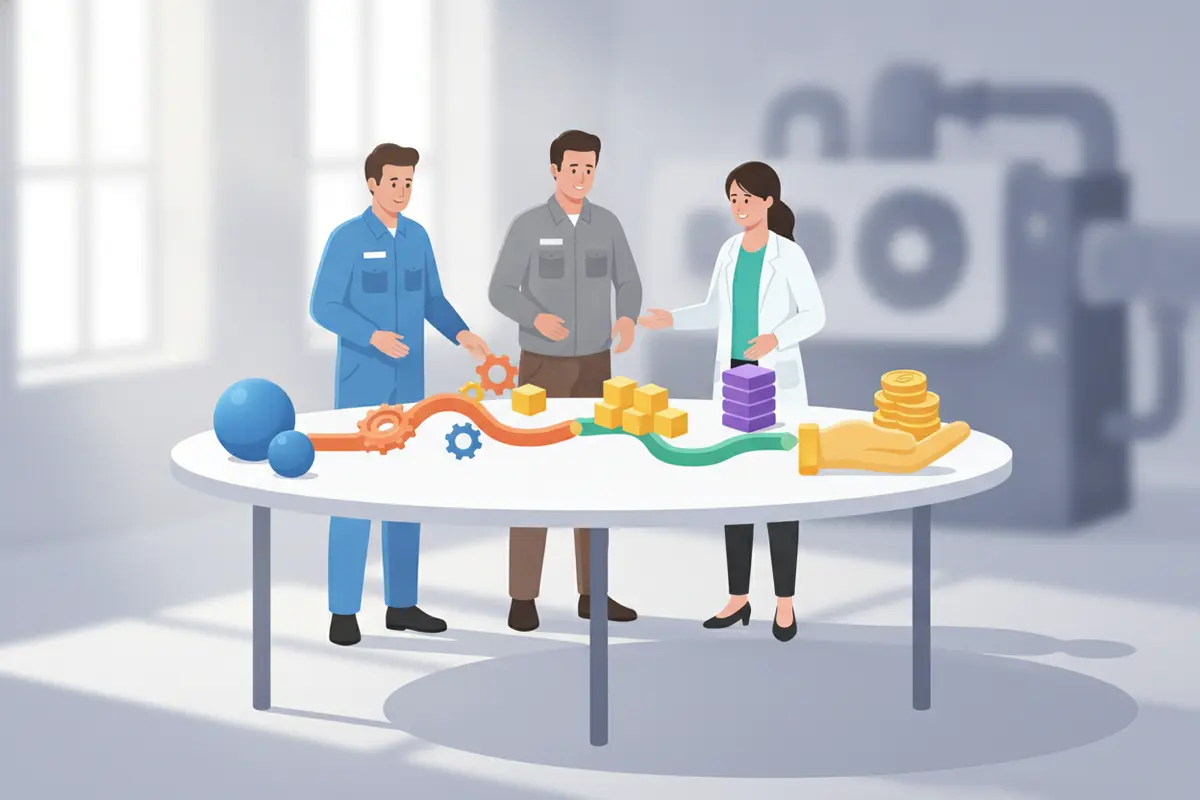
Separate a temporary timing mismatch from a structural operating deficit. Financing can address the first; recurring losses, weak margins, or poor collection practices require broader changes. Also separate a growth gap from a forecasting gap. If an order is profitable but requires material purchases well before the customer’s payment date, a planned funding solution may be useful. If the order is not profitable after labor, freight, scrap, and financing costs, more cash will not solve the underlying problem.
Which financing options should manufacturers compare?
There is no single product that fits every stage of the supply chain. Compare the purpose of the funds, the event that triggers payment, and the full cost rather than relying on the product label.
| Option | Typical use | What to check |
|---|---|---|
| Buyer-led supply chain finance | Supplier receives payment before the buyer’s due date on an approved payable | Buyer participation, invoice approval, fees, recourse, and effect on supplier terms |
| Receivables or invoice financing | Manufacturer accesses cash against eligible customer invoices after delivery | Eligibility, fee basis, customer notification, control of collections, and recourse |
| Business line of credit | Flexible short-term needs across purchasing and operations | Rate, draw and renewal terms, collateral, covenants, and personal guarantees |
| Equipment financing | Acquisition of machinery or other long-lived production assets | Down payment, repayment period, asset security, and total cost |
| Inventory financing | Funding tied to eligible inventory | Advance basis, eligible goods, monitoring, storage, and liquidation terms |
These are broad categories, not interchangeable offers. A short-term receivable may not be the right collateral for a multi-year equipment purchase. Likewise, a credit line can provide flexibility, but its availability and cost may depend on underwriting and facility terms. See the overview of B2B invoice financing and the separate guide to working capital loans when evaluating those paths.
A useful comparison starts with the trigger for repayment. Buyer-led finance is tied to an approved payable. Receivables finance is tied to a completed sale and an invoice. Inventory finance is tied to goods held in stock. Equipment finance is tied to an asset with a longer useful life. Matching the repayment trigger to the cash event can make the plan easier to forecast.
How does buyer-led supply chain finance work?
In a common buyer-led arrangement, a supplier delivers goods or services and submits an invoice to its customer. Once the buyer approves the invoice, a finance provider may offer the supplier an earlier payment. The buyer then pays the provider according to the agreed payment date. The buyer’s credit profile and approval process can influence the terms available to the supplier.
For manufacturers, this may help a supplier bridge the period between delivery and the buyer’s scheduled payment. It can also support continuity when a supplier needs cash to purchase materials for the next production cycle. But participation is not automatic. Suppliers need to understand fees, approval timing, documentation, and whether the arrangement changes their existing commercial terms.
Ask the buyer and provider who approves invoices, how disputes pause payment, whether early payment is optional, and what happens if an invoice is adjusted or rejected. A program is only useful if it works with the actual order, receiving, and accounts payable process. A supplier should also confirm whether early payment changes the amount owed, the due date, or any negotiated discount.
A report from the Corporate Finance Research Foundation on supply chain finance discusses DSO, cash availability, and working capital. Use such material as background; assess the terms and implications of the specific agreement in front of you.
When might invoice financing fit a manufacturer?
Receivables financing addresses the interval after a manufacturer has completed work and issued an eligible invoice, but before the customer pays. That can be relevant when production and fulfillment are complete yet payment terms leave cash tied up in accounts receivable.
Some arrangements let a business select particular invoices rather than financing all eligible receivables. With Now’s Revenue On Demand, a business submits invoices or connects its accounting system, selects approved invoices, and can receive payment within 24–48 hours, subject to approval and applicable terms. The business remains the biller. It is a way to access revenue on completed invoices, not a substitute for financing raw materials before production.

Review the invoice’s status carefully. Is the order delivered and accepted? Are there quality claims, deductions, missing paperwork, or a customer dispute? An invoice that may be short-paid or delayed in approval can be a poor fit for an immediate cash plan. For details on the sequence, see how invoice activation works and the guide to qualifying for invoice financing.
Consider a simple example. A manufacturer ships a completed $100,000 order on June 1 under net-60 terms. Payroll, freight, and the next material purchase are due before July 31. If the invoice is approved and eligible, accessing some or all of that invoice value may help the business cover the planned gap. The manufacturer should still verify customer acceptance, preserve documentation, and compare the fee with the cost of delaying the next production run.
How can you compare the real cost?
Compare the dollars paid for access to cash with the time and business outcome it enables. Ask for a written explanation of every fee, how it is calculated, when it is charged, and whether it changes if the customer pays late. Also check for application, activation, wire, servicing, minimum-use, or termination fees.
For example, a $100,000 invoice with 30-day terms and a 2.75% flat fee would have a $2,750 fee under the pricing described for Revenue On Demand, before considering any other applicable charges or eligibility terms. The exact cost and timing depend on the approved invoice and agreement. Compare the fee with the cost of other available capital and with the consequences of waiting, such as delaying a purchase or straining a supplier relationship. Do not treat potential sales or avoided delays as guaranteed returns.
Now’s published pricing lists flat fees by invoice terms: 2.75% for 30-day terms, 5.25% for 60-day terms, and 7.50% for 90-day terms, plus a one-time activation fee. Check the current pricing page and the agreement for current details. For any product, calculate total dollars over a realistic timeline, including the possibility that an invoice is paid after its stated due date.
- Fee basis: Is the charge fixed, time-based, or compounded?
- Advance and reserves: How much cash arrives up front, and is a portion held back?
- Recourse: Who bears the loss if the customer does not pay, and what exceptions apply?
- Operations: Who invoices, contacts the customer, and applies cash?
- Flexibility: Can you select individual invoices, repay early, or stop using the product?
- Timing: When does the fee begin, and how quickly can approved funds arrive?
Read more about invoice factoring rates and fee structures before comparing a quote. A low headline rate may not represent the lowest total cost if reserves, time-based charges, or additional conditions apply.
What risks and process issues should you check?
Financing changes cash timing; it does not remove the need to manage order execution and collections. A production delay can shift shipment and invoicing dates. A customer dispute can hold up approval. A concentration in one buyer may affect eligibility or limit how much support is available. Build these possibilities into forecasts.
Confirm what the provider requires for a valid invoice. Supporting records can include a purchase order, proof of delivery, acceptance confirmation, and any required compliance documents. Align sales, operations, and finance on who supplies each document. A missing signature or mismatched order number can slow approval when the business expects cash.
Check customer relationship implications. Some financing models involve the provider in collections or notify the customer; others allow the manufacturer to remain the biller and manage the relationship. Clarify the process before signing, and make sure customer communications are consistent with contract terms.
Review concentration risk as well. If most eligible invoices come from one customer, a change in that customer’s purchasing pattern can affect available cash. If customers have long approval cycles, model the time between shipment, acceptance, invoice approval, and payment instead of relying only on stated terms.
Finally, assess repeat use. If the business depends on financing every invoice to meet payroll or routine expenses, revisit margins, payment terms, and working capital planning. Financing can support an intentional growth plan, but persistent dependence may signal a deeper mismatch between cash needs and the operating model.
How can a manufacturer choose a practical approach?
- Identify the gap. Forecast cash by week, including material deposits, payroll, freight, overhead, and expected collections. Mark the point when cash falls below the operating buffer.
- Match the tool to the need. Use a solution designed for the relevant stage: pre-production purchasing, inventory, equipment, or a completed receivable. Avoid using short-term cash against invoices to fund long-lived assets without considering duration and repayment.
- Model a realistic case. Include slower customer approval, payment delay, deductions, and a lower-than-expected production volume. Confirm the business can handle the cost and obligations in those scenarios.
- Compare written terms. Request the total fee, advance amount, reserves, recourse rules, termination terms, and exact workflow. Compare offers on the same invoice amount and timeline.
- Run a limited operational test. Where the agreement permits, begin with a manageable set of invoices or a defined supply chain segment. Track approval time, cash received, fees, staff effort, and customer or supplier feedback.
- Review the result. Compare actual cash timing and total cost with the forecast. Continue only if the arrangement supports a clear operational purpose.
Manufacturers looking specifically at cash from completed invoices can review invoice solutions for manufacturers. For an explanation of the model and its distinctions, read what Revenue On Demand means.
What should a manufacturer prepare before applying?
Preparation can make a financing comparison more accurate and reduce avoidable delays. Gather a recent accounts receivable aging report, the invoices being considered, customer payment terms, purchase orders, proof of delivery, and records of credits or disputes. Organize the documents by customer and invoice so the status of each receivable is clear.
Next, create a short cash-use plan. State whether the proceeds will cover material deposits, payroll, freight, a supplier payment, or another defined need. Estimate when that use occurs and what cash will replenish the business. This turns a general request for working capital into a testable plan.
Include the operational owners in the review. Finance may compare fees, while sales confirms customer terms and operations confirms delivery status. A provider’s process should be practical for all three groups. Write down who submits documents, who responds to questions, and who updates the forecast when an invoice is delayed or adjusted.
Frequently asked questions
Is supply chain finance the same as a business loan?
No. The phrase covers several arrangements, including buyer-led early payment programs and financing against receivables. A loan or credit line is a different product with its own repayment, pricing, and underwriting terms. Review the actual agreement rather than relying on a broad label.
Can a manufacturer use supply chain finance to pay for raw materials?
Possibly, depending on the product and eligibility. A buyer-led program may improve a supplier’s access to payment on an approved payable, while inventory financing or a credit line may address purchasing needs. Financing against a finished, approved customer invoice generally applies later in the cycle, after delivery and invoicing.
Does invoice financing cover a disputed invoice?
Not necessarily. Providers set eligibility requirements, and disputes, deductions, or incomplete delivery documentation may delay approval or make an invoice ineligible. Confirm the rules for disputed or adjusted invoices before relying on proceeds for a committed expense.
What should be included in a financing comparison?
Compare total cost over the expected payment period, cash advanced, any reserve, fees if payment is late, recourse and exceptions, documentation, customer contact, and termination terms. Also assess whether the financing matches the life of the underlying need.
Discuss your invoice cash flow with a specialist
The best financing choice is the one that fits the specific cash gap, works with your order-to-cash process, and has clear costs and obligations. Map the cycle first, then compare written terms against realistic operating scenarios.